
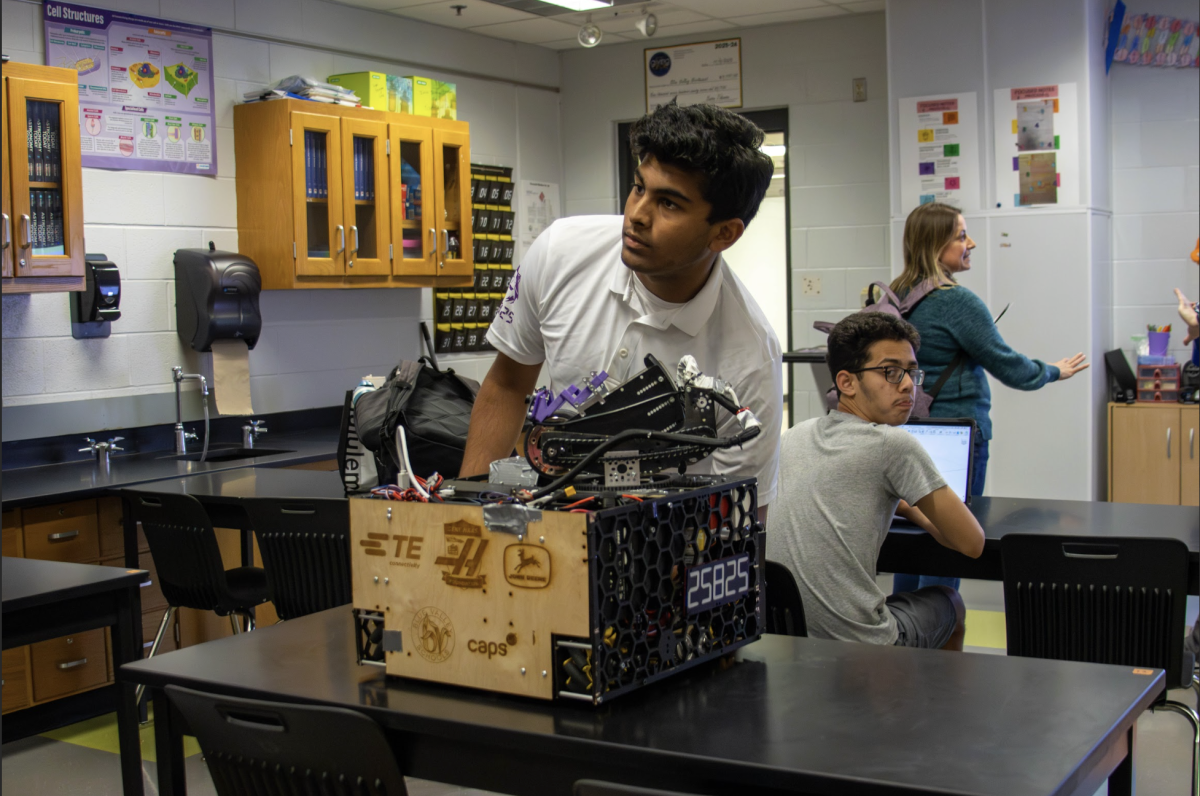
“[We] don’t care about the robot,” senior Srijan Singh said. Singh is the co-captain and co-founder of the Blue Valley Northwest robotics team.
Instead, he said he wants students to focus on their personal growth. “I really hope students can get away from the competitive aspect of it. Don’t get me wrong, I want them to care about it, but I don’t want them for that to cloud everything else that comes with the robotics. That includes working with teammates or taking those intellectual risks and being ambitious, even though it might not work out on a competitive standpoint,” Singh said.

Singh has been doing robotics since his freshman year, and started his own team the summer of his sophomore year. “I really wanted to leave an impact in the Blue Valley district, not just my school, by starting a team, but I wanted to kind of spread robotics to other students,” Singh said.
He said he was inspired by an event at Harmony Middle School, where many students were excited about robotics but felt disheartened that they couldn’t participate until high school. “That kind of sparked this internal motivation to bring robotics to them,” he said.
To make this a reality, the robotics team applied for the Women’s Giving Circle grant, hoping to fund robotics programs at the feeder schools.“There were about 150 to 200 plus grant submissions, and they take only three out of those,” Singh said.
According to Singh, after weeks of hard work, the team secured a $10,000 grant. The grant they received was split between two of the feeder schools, Oxford Middle School and Cottonwood Point Elementary.
Senior Rowan Juhl, field captain and lead programmer of the high school team, said that the curriculum they’re introducing is designed to create learning environments where students can grow and explore their interests.
“5,000 dollars goes to each school, and that covers FTC class packs,” Juhl said. “These class packs actually give them set curriculums, the parts, the materials and then the learning blocks to then create small robots.”
The curriculum is not merely focused on competition; instead, it emphasizes hands-on learning and exploration. “We think that anyone who has the opportunity to enjoy robotics will not only have fun while doing it, but will learn valuable skills that’ll help them whether they go into engineering or law or medicine or whatever they might go into,” Juhl said.
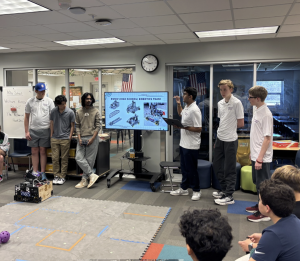
As the program progresses, the team works to maintain connections with the younger students. “We’re trying to stay connected, so they know us, they know our program, and then when they get to the high school, they’ll really be able to join the team and be a good working part of us,” Juhl said.
The team creates these connections in many different ways. “We did a robot showcase to garner interest and kind of inform students what robotics is all about and what their curriculum is about. We’re trying to get a biweekly mentoring session set up, or at least some kind of mentoring system, where our robotics team will go over there on a biweekly to monthly basis and mentor students there. Because the reality is, again, you can’t just hand these curriculums and expect students to understand them,” Singh said.
Juhl’s connection to the younger students is personal, as his little brother is a part of the Oxford robotics team. “[My brother] and I have a really good connection, and I’ve always enjoyed working with him. But it’s cool that he’s kind of been able to find something that he can enjoy and something that he can work at and challenge himself,” he said. “I’m here to help him and let him learn. It’s not me doing the coding; it’s me helping him get started and then seeing what he can do.”
According to Juhl, the team hopes the program’s impact can spread in the Blue Valley community. “We are hoping that Blue Valley sees, oh, this is making a difference,” he said.
For young students, the benefits of engaging with robotics extend beyond technical skills. Juhl said that students learn skills that will equip them not only to excel in engineering but to tackle challenges in various aspects of life. “I think it’s important for people to experience that early on, so that when they see problems in the future, they are able to use the same sort of engineering, critical thinking and problem solving to overcome it,” he said.
According to Juhl, as the Robotics for All program continues to evolve, they don’t just create robots, but also relationships and connections. “These robotics teams are not just teams, but also learning spaces for them to grow,” he said.


![Junior Aashrita Kambhampati practices harmonizing in Chamber choir class on Feb. 18. Kambhampati says that she is excited to participate in SWACDA National choir this year, “[It is] a great opportunity [to be] able to meet so many new people,” she said.](https://bvnwnews.com/wp-content/uploads/2026/02/Screenshot-2026-02-25-at-2.23.01-PM-1200x802.png)